

Last Updated: October 26, 2026
Quick Summary
The best sensitive skin swimwear pairs certified low-residue fabrics with generous coverage, so we rank OEKO-TEX Standard 100 or GOTS certification ahead of any recycled or organic fiber claim. Our top pick is the Long Sleeve Swimsuit at $125, made from 80% nylon and 20% spandex with UPF 50+ protection. Rinsing in cold fresh water immediately after every swim is the step that matters most for reactive skin.
- OEKO-TEX Standard 100 tests finished fabric for formaldehyde, heavy metals, and azo dyes.
- Disperse dyes used on synthetics are most commonly linked to contact dermatitis in patch testing.
- The Boyshort Long Sleeve Swimsuit at $130 adds built-in shorts to prevent inner thigh chafe.
- The Women's Seize the Ray Rashguard costs $62 and reuses roughly 13 plastic water bottles each.
- Wash after two or three wears with mild, fragrance-free detergent and never machine dry.
Table of Contents
- Why Sustainable Swimwear for Sensitive Skin Needs Different Standards
- Swimwear Fabrics for Sensitive Skin: What to Look For
- 1. Long Sleeve Swimsuit: Full-Coverage UPF 50+ Protection
- 2. Boyshort Long Sleeve Swimsuit: Coverage With Built-In Shorts
- 3. Get Soaked Sleeveless Swim Top: A Built-In Bra Without Sleeves
- 4. Dive In Swim Leggings and Jump In 3/4 Swim Leggings
- 5. Splash Around Swim Dress and Sarong: Coverage That Leaves the Water
- 6. Women's Seize the Ray Rashguard and Swim and Sport Tee
- How to Wash a Swimsuit to Reduce Skin Irritation
- Frequently Asked Questions
Why Sustainable Swimwear for Sensitive Skin Needs Different Standards
The global swimwear market was projected to reach $23.95 billion in 2026, according to Fortune Business Insights' swimwear market analysis, and sustainable swimwear is growing faster than the category as a whole. Yet most "eco" labels tell you nothing about what touches your skin for hours in salt water and sun. At Line In The Sand, we build sensitive skin swimwear around a different question: not just what the fabric saves, but what it does to the body wearing it.
The answer comes down to three things: fiber chemistry, dye and finish residues, and how much skin the garment covers. A recycled content claim addresses only the first.
Swimwear Fabrics for Sensitive Skin: What to Look For
Most sustainable swimwear guides tell you to look for recycled nylon and call it a day. That advice addresses the ocean, not your skin. For sensitive skin, the fabric question is really a chemistry question: what is in the fiber, what is on the fiber, and how does it behave against your skin barrier when wet, warm, and pressed under a strap for hours.
Here is the shortlist we would check before buying, ranked by irritation risk first and environmental footprint second:
- Regenerated nylon (ECONYL and similar) for stretch, quick drying, and chlorine resistance, but only when the finished fabric carries a skin-safety certification, because the recycling process and dye bath can leave residues
- Certified organic cotton or hemp for breathability, with the caveat that it stretches, dries slowly, and holds pool water against the skin longer
- OEKO-TEX Standard 100 certified textiles, which test finished fabric for restricted substances including formaldehyde, heavy metals, and azo dyes
- GOTS certified textiles, which cover organic fiber content plus chemical and processing standards
- Non-chafe lining and flatlock seams at the neck, underarm, and leg openings
- UPF 50+ fabric, which reduces reliance on sunscreen in the first place
For a deeper walkthrough of fabric ratings and coverage, see our guide to sun protective clothing for sensitive skin.
The Dermatological Angle: Why Recycled Synthetics Can Still Irritate
A recycled content claim tells you where the plastic came from. It tells you nothing about what happened to that plastic on its way to becoming fabric.
The two mechanisms most worth understanding:
1. Chemical residues from dyeing and finishing. Synthetic fabrics are dyed with disperse dyes, which are the dyes most commonly associated with contact dermatitis in textile patch-testing literature. Finishing agents, softeners, anti-static treatments, water repellents, can also remain on the fabric. A general "recycled" or "eco" label does not test for any of this. OEKO-TEX Standard 100 does, which is why we treat it as the minimum filter for sensitive skin, not a nice-to-have.
2. Microplastic and fiber shedding against the skin. Recycled synthetics shed microfibers during wear and washing. For most people this is an environmental concern, not a skin one.
A common pattern dermatologists describe: irritation from swimwear is rarely caused by the fiber name on the label. It is caused by dye residue, formaldehyde-based finishes, fragrance from detergents, and friction from seams and fit. That is why the fabric shortlist above puts certifications and construction ahead of fiber origin.
Recycled Nylon vs. Natural Fibers: The Trade-Off
Recycled nylon wins on performance. A published fabric guide from Sarah Marie Day's sustainable swimwear guide lists stretch, quick drying, shape recovery, and resistance to saltwater, chlorine, and sun as advantages synthetics hold over natural fibers.
Natural fibers win on breathability and on avoiding synthetic exposure. Natasha Tonic, for example, makes swimwear from certified organic hemp and cotton.
Our take: for active water sports, regenerated nylon is the better base. For lounging and low-impact wear, natural blends are comfortable.
If you have eczema, contact dermatitis, or a known dye sensitivity, treat the fabric label as marketing and the certification as the actual safety data. A recycled nylon suit with OEKO-TEX Standard 100 certification is a safer bet for reactive skin than an uncertified organic cotton suit that holds chlorine against your skin. ::: Prioritizing these rigorous standards ensures that your wardrobe remains a sanctuary for your complexion, a principle that extends far beyond the beach when choosing skin-friendly clothing.
Here is the fabric shortlist we would check before buying, ranked by irritation risk first and environmental footprint second.
| Fabric or feature | Best for | Key note |
|---|---|---|
| Regenerated nylon (ECONYL and similar) | Stretch, quick drying, chlorine resistance | Only with a skin-safety certification on finished fabric |
| Certified organic cotton or hemp | Breathability | Stretches, dries slowly, holds pool water against skin |
| OEKO-TEX Standard 100 | Restricted substance testing | Tests for formaldehyde, heavy metals, azo dyes |
| GOTS certified textiles | Organic fiber plus processing standards | Covers chemical and processing standards |
| Non-chafe lining and flatlock seams | Neck, underarm, leg openings | Reduces friction irritation |
| UPF 50+ fabric | Reducing sunscreen reliance | Blocks most UV on covered skin |
1. Long Sleeve Swimsuit: Full-Coverage UPF 50+ Protection
Our top pick for sensitive skin is the Long Sleeve Swimsuit. Full-length sleeves and a fitted silhouette mean less skin exposed to sun, salt, and pool chemicals, and UPF 50+ fabric reduces how much sunscreen you need on your arms and shoulders.

The fabric is 80% nylon and 20% spandex with quick-drying stretch, so it moves through swimming and surfing without clinging. At $125, it costs more than a basic one-piece, and that is the honest trade-off: coverage and durability.
Best for: swimmers and surfers who want arms and shoulders covered all day. Skip if: you want a minimal-coverage suit for pool lounging.
2. Boyshort Long Sleeve Swimsuit: Coverage With Built-In Shorts
The Boyshort Long Sleeve Swimsuit adds one feature the long sleeve version lacks: built-in shorts. That solves the most common chafe point for sensitive skin, the inner thigh, without a separate layer. A back zipper keeps the neckline secure.

Same 80% nylon, 20% spandex construction and UPF 50+ rating, at $130. If you paddleboard, snorkel, or hike to a swimming hole, this is the version we would choose.
3. Get Soaked Sleeveless Swim Top: A Built-In Bra Without Sleeves
Not everyone wants sleeves. The Get Soaked Sleeveless Swim Top with Built-in Bra gives you UPF 50+ coverage across the chest and back with a built-in bra, made from 100% regenerated nylon Carvico fabric and a YKK zipper built from recycled PET bottles.

It is sized for roughly A-D cup sizes; larger cups should order up. At $125, it pairs with any of the leggings below. Best for: paddleboarding, biking, and swimming where arm freedom matters.
4. Dive In Swim Leggings and Jump In 3/4 Swim Leggings
Leggings are the single biggest change you can make for sensitive skin, because they remove the sunscreen-and-sand cycle from your legs entirely. Both pairs use 100% regenerated nylon Carvico fabric with UPF 50+ protection and quick-drying performance.
The full-length Dive In Swim Leggings run $125; the 3/4-length Jump In Swim Leggings run $110. We recommend the 3/4 cut for warmer water and the full length for snorkeling and long paddle sessions. Leggings feel tighter than shorts when wet, so check the size chart rather than guessing.
5. Splash Around Swim Dress and Sarong: Coverage That Leaves the Water
The Splash Around Swim Dress is the most versatile piece in the lineup. Side ties cinch it into a tunic; loosened, it falls to a longer length. Wear it over a suit for swimming or on its own for the walk back from the beach. It is $155, made from regenerated nylon with UPF 50+ protection.
The Sarong adds a lighter layer at $50 for resort days and travel. Customer Tara Braswell calls the swim dress "so flattering, comfortable, and dries fast," which matches what most buyers ask us about first: whether it works off the sand.
6. Women's Seize the Ray Rashguard and Swim and Sport Tee
For everyday wear, the Women's Seize the Ray Rashguard is the practical pick. It is made from 100% Repreve recycled microfiber polyester with UPF 50+ protection, moisture-wicking properties, and anti-microbial technology, and each shirt reuses roughly 13 plastic water bottles. At $62, it is the lowest-cost entry point in the line.
The Swim and Sport Tee ($95) is the lighter, quicker-drying option for layering over a suit. Neither is a swimsuit, and that is the point: coverage you can wear to the store after the beach without looking like you just left the water.
How to Wash a Swimsuit to Reduce Skin Irritation
Rinsing is the step most people skip, and it is the one that matters most for sensitive skin swimwear.
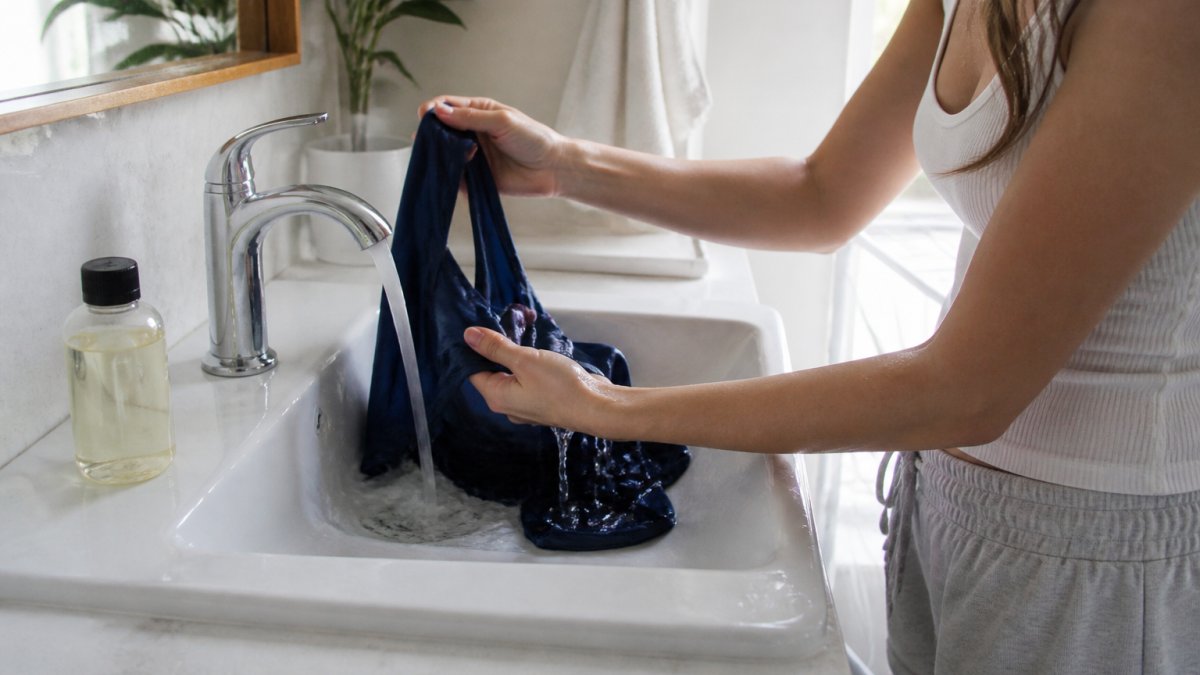
Follow this routine:
- Rinse in cold fresh water immediately after every swim, before the suit dries
- Wash after two or three wears with a mild, fragrance-free detergent
- Skip fabric softener and bleach, which leave residue and break down stretch fibers
- Hang to dry in shade; never put swimwear in a dryer
- Turn the suit inside out so the lining dries fully
Every Line In The Sand piece carries the same care instruction: machine wash cold, hang to dry. Do that and a regenerated nylon suit holds its shape and color.
Frequently Asked Questions
What swimwear fabrics are best for sensitive skin?
Look for smooth, quick-drying fabrics with a soft hand feel and few seams against the skin. Regenerated nylon like the Carvico fabric used in Line In The Sand's swim tops and leggings is chlorine resistant and dries fast, which limits how long damp fabric sits on your skin. Natural fibers such as organic cotton and hemp feel soft but stretch less and dry slowly, so they suit lounging better than lap swimming. Whatever you choose, rinse it after every wear.
Can recycled swimwear irritate sensitive skin?
Recycled content alone does not make a suit irritating. What matters is the finished fabric: dyes, finishes, and seam placement sit against your skin, not the fact that the nylon started as ocean waste. Line In The Sand's regenerated nylon pieces are built with a smooth, quick-drying finish. Patch test a new suit for a short swim before committing to a long day in it.
Is UPF 50+ swimwear suitable for sensitive skin?
Yes. UPF 50+ fabric blocks most UV radiation before it reaches your skin, which matters if sun exposure triggers reactions or if you are avoiding sunscreen on sensitive areas. Line In The Sand's UPF 50+ swimwear covers shoulders, arms, and legs in pieces like the long sleeve swimsuit and swim leggings. Coverage does not replace sunscreen on exposed skin, but it reduces how much you need to apply and reapply.
How do I wash a swimsuit to reduce skin irritation?
Rinse the suit in cold water immediately after swimming to clear salt, chlorine, and sunscreen residue. Wash by hand or on a cold delicate cycle with a mild, fragrance-free detergent, then hang it to dry out of direct sun. Skip fabric softener and dryer sheets, which leave residue on the fibers. Line In The Sand recommends machine washing cold and hanging to dry for its regenerated nylon pieces, which keeps the fabric smooth and extends its life.
Which sustainable swimwear brands offer size-inclusive styles?
Check the size chart before you buy rather than trusting a marketing claim. Line In The Sand's swim leggings, swim dress, and rashguards run from XSmall through XXLarge, and the sleeveless swim top is cut for roughly A-D cup sizes with a recommendation to size up for larger cups. Read reviews from shoppers in your size, and confirm the brand publishes measurements rather than only letter sizes.
